Defending Democracy
To defeat demagogues like Donald Trump, citizens must vote to defend democracy, otherwise it will not be there to defend them. Taking off from Max Weber's 'Vocation Lectures,' David Ricci's Defending Democracy therefore explores the idea of 'citizenship as a vocation,' which is a commitment to defending democracy by supporting leaders who will govern according to the Declaration of Independence's self-evident truths rather than animosity and polarizations. He examines the condition of democracy in states where it is endangered and where modern technology – television, internet, smart phones, social media, etc. – provides so much information and disinformation that we sometimes lack the common sense to reject candidates who have no business in politics. Arguing for the practice of good citizenship, Ricci observes that as citizens we have become the rulers of modern societies, in which case we have to fulfill our democratic responsibilities if society is to prosper.
- Discusses the marketplace for ideas and how it is overloaded, explaining how entertainment has replaced education in that marketplace
- Shift readers' attention away from the awful autocrats to the citizens who must (and can) contain them
- Adds to the debate over what constitutes good citizenship
To defeat demagogues like Donald Trump, citizens must vote to defend democracy, otherwise it will not be there to defend them. Taking off from Max Weber's 'Vocation Lectures,' David Ricci's Defending Democracy therefore explores the idea of 'citizenship as a vocation,' which is a commitment to defending democracy by supporting leaders who will govern according to the Declaration of Independence's self-evident truths rather than animosity and polarizations. He examines the condition of democracy in states where it is endangered and where modern technology – television, internet, smart phones, social media, etc. – provides so much information and disinformation that we sometimes lack the common sense to reject candidates who have no business in politics. Arguing for the practice of good citizenship, Ricci observes that as citizens we have become the rulers of modern societies, in which case we have to fulfill our democratic responsibilities if society is to prosper.
- Discusses the marketplace for ideas and how it is overloaded, explaining how entertainment has replaced education in that marketplace
- Shift readers' attention away from the awful autocrats to the citizens who must (and can) contain them
- Adds to the debate over what constitutes good citizenship
Description
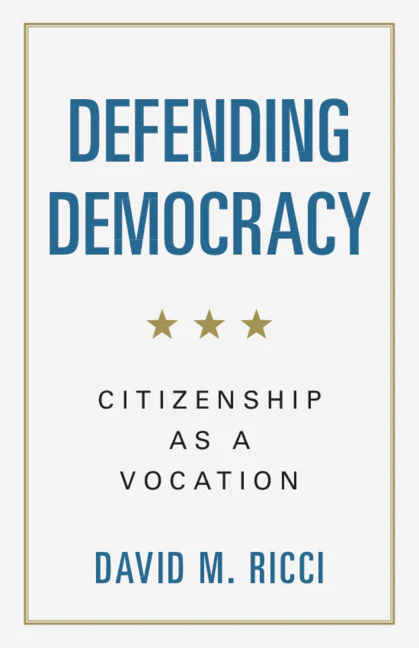
To defeat demagogues like Donald Trump, citizens must vote to defend democracy, otherwise it will not be there to defend them. Taking off from Max Weber's 'Vocation Lectures,' David Ricci's Defending Democracy therefore explores the idea of 'citizenship as a vocation,' which is a commitment to defending democracy by supporting leaders who will govern according to the Declaration of Independence's self-evident truths rather than animosity and polarizations. He examines the condition of democracy in states where it is endangered and where modern technology – television, internet, smart phones, social media, etc. – provides so much information and disinformation that we sometimes lack the common sense to reject candidates who have no business in politics. Arguing for the practice of good citizenship, Ricci observes that as citizens we have become the rulers of modern societies, in which case we have to fulfill our democratic responsibilities if society is to prosper.
- Discusses the marketplace for ideas and how it is overloaded, explaining how entertainment has replaced education in that marketplace
- Shift readers' attention away from the awful autocrats to the citizens who must (and can) contain them
- Adds to the debate over what constitutes good citizenship