The Cambridge Companion to Leo Strauss
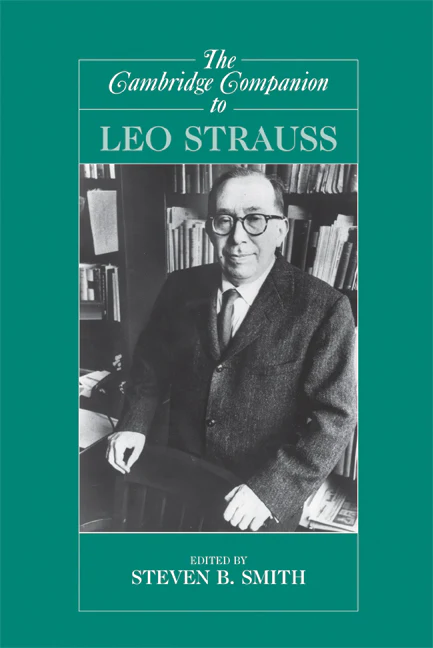
Leo Strauss was a central figure in the twentieth century renaissance of political philosophy. The essays of The Cambridge Companion to Leo Strauss provide a comprehensive and non-partisan survey of the major themes and problems that constituted Strauss's work. These include his revival of the great 'quarrel between the ancients and the moderns,' his examination of tension between Jerusalem and Athens, and most controversially his recovery of the tradition of esoteric writing. The volume also examines Strauss's complex relation to a range of contemporary political movements and thinkers, including Edmund Husserl, Martin Heidegger, Max Weber, Carl Schmitt, and Gershom Scholem, as well as the creation of a distinctive school of 'Straussian' political philosophy.
Leo Strauss was a central figure in the twentieth century renaissance of political philosophy. The essays of The Cambridge Companion to Leo Strauss provide a comprehensive and non-partisan survey of the major themes and problems that constituted Strauss's work. These include his revival of the great 'quarrel between the ancients and the moderns,' his examination of tension between Jerusalem and Athens, and most controversially his recovery of the tradition of esoteric writing. The volume also examines Strauss's complex relation to a range of contemporary political movements and thinkers, including Edmund Husserl, Martin Heidegger, Max Weber, Carl Schmitt, and Gershom Scholem, as well as the creation of a distinctive school of 'Straussian' political philosophy.
Description
Leo Strauss was a central figure in the twentieth century renaissance of political philosophy. The essays of The Cambridge Companion to Leo Strauss provide a comprehensive and non-partisan survey of the major themes and problems that constituted Strauss's work. These include his revival of the great 'quarrel between the ancients and the moderns,' his examination of tension between Jerusalem and Athens, and most controversially his recovery of the tradition of esoteric writing. The volume also examines Strauss's complex relation to a range of contemporary political movements and thinkers, including Edmund Husserl, Martin Heidegger, Max Weber, Carl Schmitt, and Gershom Scholem, as well as the creation of a distinctive school of 'Straussian' political philosophy.